The wrong jacket makes every run a negotiation between staying warm and being able to move. You've probably worn one. The kind that traps heat on the uphill, soaks through by noon, and fits like it was designed for someone who has never skied. Choosing a women's ski jacket means knowing what's doing the real work beneath the shell, and what's just marketing.
This guide cuts through the noise. You'll find out what warmth ratings mean on a bluebird day versus a whiteout, how waterproofing and breathability trade off against each other, and which features earn their place versus just adding weight to the price tag. We've also rounded up the newest Obermeyer jackets for the 2026/27 season. Whether you're logging resort laps or mixing in variable terrain, the right jacket keeps you comfortable and out of your own head, so the only thing you're thinking about is the next run.
Table of Contents
- What Should You Look for in a Women's Ski Jacket?
- What Types of Women's Ski Jackets Are Available?
- How Do Fabrics and Technologies Impact Performance?
- Which Features Make the Biggest Difference?
- How Should a Women's Ski Jacket Fit?
- What Are the Best Women's Ski Jackets for Different Skiing Styles?
- How Do You Layer Under a Ski Jacket for Maximum Comfort?
- How Should You Care for and Extend the Life of Your Ski Jacket?
What Should You Look for in a Women's Ski Jacket?
Not all ski jackets are created equal. A jacket made for a groomed resort day in Vail is a different animal than one designed for a dawn patrol backcountry push. Before you buy, it helps to know exactly what you're buying for.
-
Weather conditions: Downhill skiing at a ski resort calls for reliable waterproofing and wind resistance. Backcountry skiing days demand more breathability to handle sustained output and unpredictable exposure.
-
Insulation type: Down runs warm and compressible but loses its edge when wet. Synthetic performs better in damp conditions. Hybrid constructions split the difference, with extra warmth where you need it and breathability where you don't.
-
Fit and layering flexibility: A jacket that fits beautifully over a base layer but fights your midlayer becomes a problem by run three. Look for a tailored fit that accommodates a full layering system without boxing you in.
-
Ease of movement and adjustability: Articulated patterning, stretch panels, and adjustable hems and cuffs decide whether a jacket moves with you or works against you all day.
Obermeyer makes each jacket to balance all of this without forcing you to choose between performance and looking like you meant to dress this well.
What Types of Women's Ski Jackets Are Available?
Most ski jackets fall into one of three categories. The right one depends on where you ski, how hard you push, and whether you run warm or spend every chairlift ride wondering why you didn't add another layer.
-
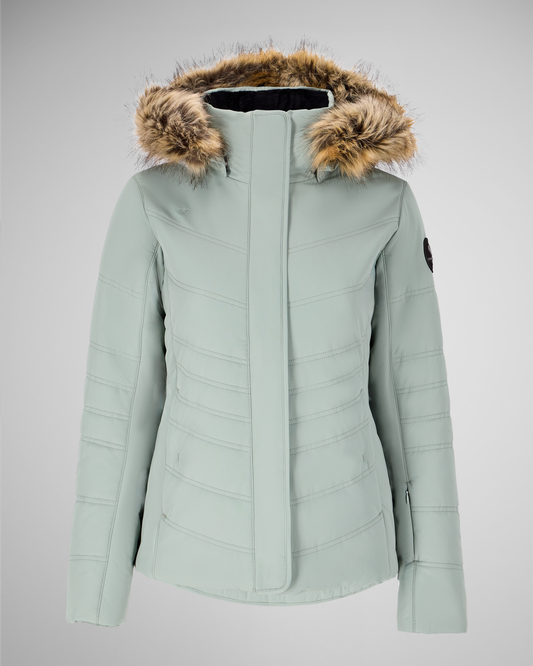
Insulated Ski Jackets: The resort workhorse. Down insulation delivers the best warmth-to-weight ratio and compresses beautifully, but loses its edge when wet. Synthetic insulation keeps performing even in damp conditions, a real advantage when the Rockies decide to dump wet snow in March or if you ski in wet climates like the Pacific Northwest. The new Snowbird Jacket pairs 100g of body insulation with a 20K waterproof shell, and the best-selling Tuscany II Jacket returns with PrimaLoft insulation in new colors. Either way, this is the category built for cold conditions and long lift lines.
-
Shell Jackets: Lightweight, uninsulated, and built to layer over whatever you need that day. Shells shine in variable conditions and high-output skiing: backcountry tours, spring slush, or any day when you'll be working hard enough to generate your own heat. New this season, the W Tagert Shell Jacket and W Steibis Shell Jacket both deliver 30K/30K protection.
-
Puffy Jackets and Mid-Layers: These pull double duty. Wear one under a shell on a serious cold day, or on its own for après and warmer spring days at the base. The new Slopeside Puffer adds a waterproof shell and removable powder skirt to a classic puffy jacket, while the Eris Down Jacket packs 700 fill power down into a streetwear-inspired cut.
Whichever category you land in, the goal is the same: a jacket that performs season-long, not just through one big storm.
How Do Fabrics and Technologies Impact Performance?
Fabric choice and construction separate real weather protection from a jacket that looks great in the lodge and soaks through by noon.
- Waterproofing ratings tell you how much water pressure a fabric can handle before it leaks. A 10K rating handles light snow and brief wet conditions; 15K to 20K+ is where serious resort skiers want to be. The newest Obermeyer jackets range from 10K (Slopeside Puffer and Sojourner Down) to 20K (Snowbird and Tuscany Lite) and up to 30K (W Tagert Shell and W Steibis Shell). DWR coatings bead water off the outer shell, while bonded laminates lock moisture out at the construction level. Both matter.
- Stretch fabrics and articulated seaming let you move: carving, poling, loading a chairlift without your jacket riding up. Fully taped seams close the gaps where water sneaks in when waterproof fabric alone isn't enough.
- Obermeyer works recycled and responsible materials into its women's line, from REPREVE recycled polyester in the Tuscany II and Cosima to traceable down in the Eris and Sojourner. The new W Steibis Shell Jacket uses nylon made with yarn from recycled ocean waste.
Which Features Make the Biggest Difference?
The features you notice most aren't always the ones on the hang tag. They're the ones you reach for when the wind picks up on the chairlift or your hands are full of poles and you're fumbling for your ski pass.
-
Adjustable hood and cuffs: A helmet-compatible adjustable hood that cinches with one hand keeps you sealed in when the weather turns. Cuffs that seal tight over gloves keep cold air out on frigid chairlift rides.
-
Powder skirt and wrist gaiters: Your first real powder day will make you a believer. Both seal out snow exactly where it tries to sneak in.
-
Venting systems: Pit zips or chest vents let you release excess body heat fast on a long groomer without stripping layers mid-run.
-
Ski pass pocket: A dedicated zippered pass pocket keeps your ski pass where you can reach it without breaking stride.
-
Glove-friendly zippers: Oversized pulls are a small detail that feels enormous at minus fifteen.
-
Reinforced high-wear zones: Shoulders and cuffs take the most abuse. Reinforced fabric there means the jacket lasts more than one season.
-
Avalanche safety: A built-in RECCO reflector helps organized rescue teams locate you. The new W Tagert Shell and W Steibis Shell jackets both include one. It doesn't replace an avalanche transceiver, but it's a smart backup for backcountry skiing.
How Should a Women's Ski Jacket Fit?
Most jackets fail the fit test the moment you raise your arms overhead. The best fit balances a flattering silhouette with real freedom of movement, whether you prefer a relaxed fit or something closer to the body, with enough room to layer underneath without reading like a sleeping bag with sleeves.
- Size for your layering system, not just your body. You need space for a base layer and a mid-layer underneath without pulling across the shoulders or riding up at the hem.
- Do the reach test in the fitting room. Raise both arms overhead; if it feels awkward or the hem lifts above your waistband, size up or look for a longer cut.
- Add the squat test too. Your mobility on a steep pitch depends on it. If it binds through the hips, it'll slow you down on the mountain.
- Obermeyer's women's jackets are designed across a range of inclusive fits and sizes, built for real bodies and real movement, not a fit model standing perfectly still. Most styles run from size 0 to 20 or 22, and the new Snowbird and Sojourner Down jackets also come in Petite lengths.
What Are the Best Women's Ski Jackets for Different Skiing Styles?
The best ski jacket depends on what your day looks like, but for most skiers it comes down to balancing warmth and mobility. Groomers and a long lunch at the lodge call for different priorities than skinning up a ridge before dawn.
-
Resort Skiers: Warmth and convenience win here. Look for integrated features like a ski pass pocket, media pocket, and a cozy insulated build that holds up from first chair to the last run down the ski hill. The Snowbird and Tuscany II jackets are built for exactly this.
-
Backcountry Skiers: Weight and breathability come first. A lightweight, highly breathable shell with articulated mobility, like the W Tagert Shell or W Steibis Shell, keeps you comfortable on the skin track and moving freely on the descent.
-
All-Around Skiers: Obermeyer offers a range of versatile insulated jackets for skiers who want one jacket to do it all, technical enough for a powder day and polished enough for the deck late afternoon. The Cosima Down Jacket uses mapped down insulation to put warmth where you need it most.
-
Style-Conscious Skiers: Obermeyer's approach to elevated simplicity means you don't have to choose between performing well and looking timeless. The new Eris and Sojourner down jackets bring clean lines and refined fits that hold up on the mountain and off it.
New Women's Ski Jackets for the 2026/27 Season
This season's newest styles cover every kind of skier, from resort regulars to backcountry tourers to anyone who wants one jacket for the mountain and the city.
-
Snowbird Jacket: A resort-ready insulated jacket with 20K waterproofing, an active fit, a helmet-compatible hood, and underarm vents. Available in Regular and Petite lengths.
-
Slopeside Puffer: A waterproof puffy jacket with 600 fill-equivalent synthetic insulation, an adjustable hood, and a removable powder skirt, made for days on and off the slopes.
-
Eris Down Jacket: Ultra-warm 700 fill power down in a relaxed, streetwear-inspired design with an adjustable waist for shape.
-
Sojourner Down Jacket: An extra-long, contoured down jacket with a removable faux fur collar and a 2-way front zipper, built for everyday winter wear.
-
W Steibis Shell Jacket: A 3-layer, 30K/30K shell from the Off Grid collection with a RECCO reflector and magnets that connect to the matching bib.
Favorites like the Tuscany II, Tuscany Lite, Cosima Down, and Bombshell Luxe jackets also return in new colors. Browse every new style in Women's New Arrivals.
How Do You Layer Under a Ski Jacket for Maximum Comfort?
Your jacket does a lot of the heavy lifting, but what's underneath determines whether you're comfortable on chair nine or miserable by run three. The goal is a system that moves moisture away from your skin, traps warmth efficiently, and doesn't turn you into a marshmallow the moment you start generating heat.
- Moisture-wicking base layer first. Merino wool or synthetic, never cotton. Cotton holds sweat against your skin and makes a cold chairlift feel punishing.
- Fleece or a light down mid-layer adds warmth without bulk. A fitted quarter-zip is the workhorse here. Save the puffy mid-layer for truly cold days or slow resort mornings.
- Avoid overloading. More layers don't mean more comfort. They mean restricted movement and a jacket that fits wrong. If you're sweating on the skin track, you've overdone it.
A well-chosen jacket with the right fit has room for one solid mid-layer.

How Should You Care for and Extend the Life of Your Ski Jacket?
A great ski jacket is an investment. Treat it like one. The difference between a jacket that performs for ten seasons and one that starts leaking by season three usually comes down to maintenance, not materials.
- Wash on a gentle cycle with a technical outerwear cleaner, not regular detergent, which strips DWR coatings. Tumble dry on low; heat reactivates the DWR finish. It's counterintuitive, but it works.
- When water stops beading and starts soaking in, it's time to re-waterproof. A spray-on DWR treatment like Nikwax or Grangers takes ten minutes and buys you another full season of dry shoulders.
- Store it uncompressed, hanging or loosely folded in a cool, dry place. Stuffing it into a gear bag for eight months crushes the insulation and stresses the seams.
Think of jacket care as part of sustainable ski gear ownership; the less you replace, the better for your wallet and the slopes.
The best women's ski jackets keep you out there longer, moving better, and looking like you meant every turn. Match your insulation to your conditions, trust the waterproof ratings, and don't overlook the details that earn their place on the hill. Fit, fabric, and function working together is the difference between a jacket you tolerate and one you reach for every single time.
When the gear is right, the only thing left to think about is the run. Explore the full collection and find the jacket that earns its spot in your rotation.
FAQs
Do I need a different jacket for backcountry skiing?
Usually, yes. Backcountry skiing calls for a lighter, more breathable shell that vents heat on the climb and moves freely on the descent. A 30K/30K shell like the W Tagert Shell Jacket is built for both resort and backcountry days.
Can I wear my ski jacket off the mountain?
Yes. Many modern ski jackets are stylish and functional enough for everyday winter wear. The Tuscany II Jacket, one of Obermeyer's best sellers, is designed for both skiing and everyday wear.
Are all ski jackets waterproof?
Most ski jackets are water-resistant, but not all are fully waterproof, so check the rating before buying. A 20K rating like the one on the Tuscany Lite Jacket handles most resort conditions, while 30K is better for heavy, wet snow.
Should I size up to fit layers underneath?
Usually not. Obermeyer jackets are designed to allow layering while maintaining a flattering, functional fit. Start with a slim base layer like the Women's ¼ Zip Baselayer Top and try the jacket on over it to check the fit.
What's the best women's ski jacket for beginners?
Look for a well-insulated, waterproof jacket with essential features like a powder skirt and adjustable hood. The Cosima Down Jacket checks those boxes with mapped down insulation, a powder skirt, and adjustable cuffs, so you can focus on learning instead of staying warm.