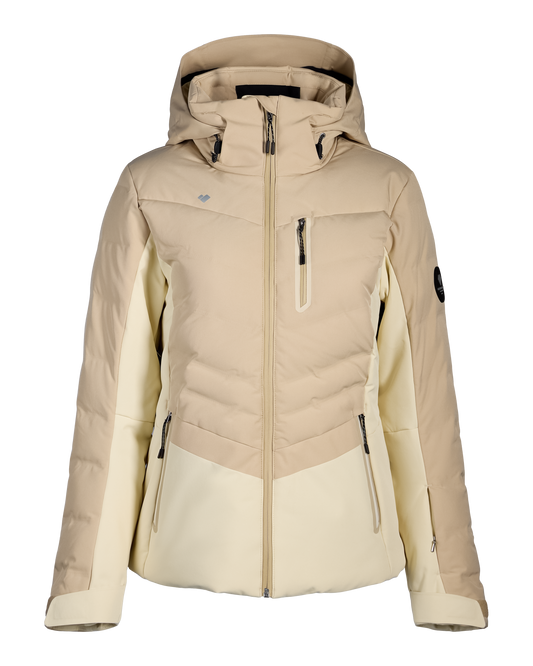
Collection: Down vs Synthetic Jacket
You're standing in the jacket aisle with two options in hand, and the tags might as well be written in a foreign language. Let's fix that.
Down versus synthetic insulation is one of those choices that actually matters on the mountain, not in a gear nerd way, but in a “why am I cold at 2 pm when I was fine at 10 am” way. The right insulated jacket works with how you ski, the conditions you ski in, and how much patience you have for babying your gear. Get it wrong, and you spend the day thinking about being cold instead of your next run.
Table of Contents
- What Does "Down vs. Synthetic Jacket" Really Mean For Skiers?
- How Does Down Insulation Perform On The Mountain?
- How Do Synthetic Jackets Compare In Real Ski Conditions?
- Which Jacket Wins On Warmth, Weather, And Longevity?
- What Should Women Look For When Choosing An Insulated Ski Jacket, And Which Is Right For You?
What Does "Down vs. Synthetic Jacket" Really Mean For Skiers?
Standing in a lift line at 7 am with wind cutting across the mountain, “insulation” stops being an abstract word fast. It's the layer inside your ski jacket that traps warm air against your body and keeps the cold out, the difference between a great day on the mountain and a miserable one. For women's ski jackets especially, how that insulation is built affects everything: warmth, packability, how the jacket moves with you, and how it holds up after a season of hard use.
Two types dominate the market, and they work in very different ways.
- Down insulation uses natural clusters, typically goose or duck, that loft to create exceptional warmth relative to weight. It compresses well, feels great, and holds its warmth reliably as long as it stays dry.
- Synthetic insulation uses engineered fibers built to copy that same loft, with one real advantage: it keeps performing even when wet, which matters more than you'd think on a bluebird morning that turns slushy by noon.
Beyond warmth and weather resistance, the comparison also comes down to weight, durability over multiple seasons, and sustainability. Down raises sourcing questions synthetic doesn't have to answer, while many synthetic insulated jackets are now made with recycled materials. Neither option wins across the board. The right call depends on where you ski, how hard you push, and what you're willing to trade off.
How Does Down Insulation Perform On The Mountain?
Down is the original warmth technology, and it's stuck around for good reason. Those fluffy clusters filling your down jacket aren't just soft; they're built to trap body heat inside thousands of tiny air pockets. The result is a warmth-to-weight ratio that synthetic insulation has spent decades trying to match. If you want a puffy jacket that feels like almost nothing on the chairlift but performs like a furnace on the way down, down is worth a serious look.
Down clusters loft outward from a central point, layering air pockets that hold warm air close to your body and reflect heat back efficiently, more warmth per gram than nearly any synthetic option. Down does its best work on cold, dry resort days when you want a low-bulk layering piece or something that packs down small without a fight.
The catch: down and moisture don't mix. Wet down collapses, loses its loft, and takes a long time to dry, which becomes a real problem in variable conditions or after a fall in wet snow. Look for a jacket using Responsible Down Standard certified fill, and consider a DWR-treated or water-resistant option if your mountain throws light moisture at you often.
If your home hill runs cold and dry, down earns its spot in your closet. If your season includes spring slush or unpredictable weather, that's worth weighing first.
How Do Synthetic Jackets Compare in Real Ski Conditions?

This is where synthetic insulation earns its keep: when the weather refuses to cooperate. Modern synthetic fills use fine, interlocking fibers engineered to mimic the structure of down clusters, so they keep trapping heat even once moisture gets involved. Caught in a sleet shower, or worked up a sweat on a long groomer run? Synthetic keeps insulating. Down, at that point, is basically a wet sponge.
Synthetic jackets are the smarter call when you're skiing in variable weather (mixed precipitation, wet snow, or mid-mountain fog that can't decide what it wants to be), when you're a high-output skier who sweats through your layers and needs insulation that won't quit once it's damp, or when durability and easy care matter most. Most synthetic jackets are fully machine washable, with no special treatment required, and synthetic fills tend to hold their loft longer under repeated compression and washing.
The honest trade-off: synthetic jackets run a little heavier than down and don't compress as neatly into a stuff sack. The warmth-to-weight ratio isn't quite as efficient. But if your ski days involve real weather instead of bluebird fantasies, that's a trade worth making.
Which Jacket Wins On Warmth, Weather, And Longevity?
“Which one is warmer” is the wrong question. The better question is: warmer where, warmer when, and warmer for how long.
Down wins on warmth-to-weight ratio. Higher fill power, think 650 and up, means more loft and more insulating power without added bulk. For bluebird groomer days or high-altitude cold, nothing else quite competes.
Synthetic holds its ground when conditions turn. Wet snow, lift line drizzle, early season slush: synthetic insulation keeps working even when damp, while wet down collapses and loses loft fast. If your home mountain tends to run warm or unpredictable, synthetic is the more dependable partner, and it especially rewards spring skiing.
For longevity, both have come a long way. Recycled synthetic fills are now durable, packable, and easier on the planet. Responsibly sourced down (look for RDS certification) addresses ethical concerns without giving up performance, and down jackets that are properly cared for and re-lofted after washing can outlast multiple seasons of hard use. Synthetic needs less maintenance but may compress over time with heavy wear.
The simplest approach: match the insulation to your season. Peak winter cold snaps favor down's efficiency, while variable conditions and spring corn skiing favor synthetic.
What Should Women Look For When Choosing An Insulated Ski Jacket, And Which Is Right For You?
The best insulation is the one that fits how you actually ski, not how your friend skis, and not whatever's trending on the mountain this season.
Fit and mobility matter more than fill power numbers on a tag. Look for articulated sleeves, seam placement that won't ride up when you pole plant, and a women's-specific cut that moves with your body through every turn. Beyond fit, other features make or break a jacket on the mountain: waterproof, breathable fabric, underarm venting for high-output laps, pockets you can reach in gloves, and a hood built to work with a helmet.
Silhouette is a real decision, not just a style choice. A streamlined fit layers cleanly under a shell and looks polished at après-ski. A puffier silhouette adds loft and warmth along with bulk, worth it if you ski in cold conditions and less so if you run warm or want mobility. Down tends to give you that classic puffer volume, while synthetic tends to lie flatter.
Obermeyer builds insulated jackets around women's movement and proportion, using environmentally conscious materials, including responsibly sourced down and recycled synthetic fills, without asking you to trade away warmth or premium performance.
Match your insulation to your skiing, not the forecast app. Cold, dry resort days favor down. Damp environments and wet weather favor synthetic, since breathability and moisture management outrank raw warmth once you're working hard, whether that's ski touring uphill or chasing groomers all day.

Final Word
Down or synthetic, neither answer is wrong. It comes down to where you ski, how hard you push, and what the weather throws at you by your third chair of the day. Wet, heavy conditions favor synthetic. Cold, dry bluebird days where packability matters favor down. The jacket that works best is the one that lets you stay warm without thinking about it mid-run.
Ready to find yours? Explore the full collection and see what's built for the way you ski.
FAQs
Is a down jacket warmer than a synthetic jacket?
Yes, down typically provides a higher warmth-to-weight ratio.
Does synthetic insulation work well in wet snow?
Yes, synthetic insulation retains warmth even when damp.
Is down or synthetic better for high-output skiing?
Synthetic is usually better because it manages moisture more effectively.
Do down jackets last longer than synthetic jackets?
Often yes; properly cared-for down can retain loft for many years.
Is synthetic insulation more affordable than down?
Yes, synthetic options are generally more budget-friendly.
-
Cosima Down Jacket 11 CouleursPrix habituel $621.14Prix soldé $621.14 Prix habituelPrix unitaire par+
-
Cristallo Jacket 1 CouleurPrix habituel $443.40Prix soldé $443.40 Prix habituelPrix unitaire par
$739.00Save 40%+